
They wish to find the answer where everything is nothing but a mystery. — Pascal
🌅 Prologue

The "Chinese Room" is a thought experiment proposed by American philosopher John Searle in 1980, intended to refute the thesis of "strong AI"—the idea that simply programming a computer appropriately doesn't just simulate the human mind, but actually gives it thoughts and cognitive states.
The experimental scenario goes like this: Searle imagines himself locked in a room, communicating via slipped notes with native Chinese speakers outside. Although Searle doesn't understand a word of Chinese, he possesses a "rulebook" (written in English) that dictates in detail the Chinese character outputs corresponding to various Chinese character inputs. By consulting this complex rulebook, Searle can provide logically coherent answers, tricking the people outside into believing he is fluent in Chinese.
Through this thought experiment, Searle argues that even if a computer can pass the Turing test, it is merely manipulating symbols (handling syntax) without understanding the meaning (semantics) behind those symbols at all. In his view, understanding the meaning of language is a necessary condition for possessing intelligence. Therefore, a computer operating solely on code cannot, in principle, possess true intelligence; strong AI is impossible to realize.
This reminds me of what Yuval Noah Harari wrote in Nexus (perhaps paraphrased):
Evaluating AI by the metric of "human-level intelligence" is just as unreasonable as evaluating an airplane by the metric of "bird-level flight." The evolutionary goal of AI is not to reach human-level intelligence, but to develop a completely different kind of intelligence.
Perhaps we can end the discussion with this sentence: AI's intelligence is different from human intelligence, AI's understanding is different from human understanding—we simply no longer understand "understanding."
In fact—as I realized only after reading the original text—John Searle had already addressed "different understanding" as an invalid counterargument. He asserted that "the computer's understanding is not partial or incomplete; it is zero." So-called "understanding" in this context is merely akin to "a thermostat sensing a change in temperature."
Reading further, one finds that the object of John Searle's discussion is "program-implemented AI," which is different from today's large language models built upon neural networks.
However, the "Chinese Room" is not entirely obsolete. Perhaps this sentence is its crux:
Cognition cannot simply be a computational process and its output, because the computational process and output can exist without cognitive states.
Do not multiply entities beyond necessity. If it is mere "computation," there is no need for "cognition."
But this is a principle that cannot be clearly explained; it is better described as a "belief."
Returning to the "Chinese Room" thought experiment, rather than debating whether "strong AI" can be achieved, there is another contemporary scenario more worthy of deep reflection:
Imagine yourself locked in a room, communicating via slipped notes with native Chinese speakers outside by asking an AI. Although you don't understand a word of Chinese, you possess a computer equipped with a local large model. By querying the AI, you can provide logically coherent answers, tricking the people outside into believing you are fluent in Chinese.
Setting aside whether AI is merely "manipulating symbols" (those who like to talk about "essence" will say "yes, it's just adding one word at a time"), let's focus on this wall-facer: life and work, deeply intervened by AI, have indeed been transformed into an "unintentional state" of "manipulating symbols."
I have almost reached this realm, or perhaps fallen into this predicament.
🐎 The Hippodrome
🗝️ Riddles

Kanae Kijima had a clear awareness of her own appearance, so she wouldn't readily meet with men. She had to make these men fall in love with her before they even saw her.
— Li Miao, Li Miao's Crime Stories
In truth, these letters were for her just a diversion, a way of keeping the embers glowing without putting her hand in the fire, while Florentino Ariza was burning himself to ashes in every line. He was desperate to infect her with his own madness, to use a pin to carve microscopic verses for her on the petals of a camellia.
— Gabriel García Márquez, Love in the Time of Cholera
Before falling asleep, a vision seemed to appear before my eyes: Luis leaning against a tree, surrounded by all of us, his hands slowly reaching for his face, tearing it off as if peeling away a mask. Holding his face in his hands, he approached his brother Pablo, me, the "Lieutenant," Roque, with an expression that seemed to ask us to accept it, to put it on. But everyone refused, one by one, and I refused too, smiling until tears flowed. So Luis put his face back on, shrugged his shoulders, pulled a cigarette from his jacket pocket, and at that moment, I saw in him an endless weariness.
— Julio Cortázar, Reunion
💧 Liquid

If found defective or not "completely satisfactory," goods can be exchanged for other, more promising items, even if the transaction does not offer after-sales service or a money-back guarantee. But even if they fulfill their promises, people do not expect them to be used for a long time; after all, once a "newer and better version" appears in stores and becomes the talk of the town, those perfectly usable, well-conditioned, and well-performing cars, computers, or mobile phones are tossed onto the scrap heap with hardly a second thought. What reason is there to think that romantic partnerships should be an exception to this rule?
— Zygmunt Bauman, Liquid Love
Digital communication has had a profoundly significant impact on human relationships. Today we are everywhere connected, yet we do not need to be related to one another. Digital communication is an outward extension. It lacks inner intensity (Intensität). Being connected is not the same as having a relationship. The third-person "it" has entirely replaced the second-person "you" today. Digital communication abolishes the personal "face-to-face" encounter; it abolishes the face, the gaze, and physical presence. In doing so, it accelerates the demise of the Other. Ghosts inhabit the cave of the identical.
— Byung-Chul Han, Non-things
Your awareness of this further increases your uncertainty—and this added portion is the hardest to bear: unlike your own choice to "stay or leave," you have no right to stop your partner from backing out of the deal. You can hardly change your partner's decision to make it favorable to you. To your partner, you are the stock to be sold off, or the loss to be cut—and before sending a stock back to the market, no one consults the stock's opinion, nor does anyone consult the loss's opinion before cutting it.
— Zygmunt Bauman, Liquid Love
In Fermina Daza's eyes, they were nothing more than borrowed friends; as soon as each class ended, the affection dissipated along with it.
— Gabriel García Márquez, Love in the Time of Cholera
When we point out our happiest moments, we also know that they are long gone and will not return, and thus they bring us pain. The only thing that makes this pain bearable is possessing an object left behind by that golden moment. The objects left by those happy moments preserve the memory, colors, touch, and visual joy of those moments far more faithfully than the people who made us experience that happiness.
— Orhan Pamuk, The Museum of Innocence
⚙️ The Console
🔤 TransLit
Related link: VibeCoding - TransLit
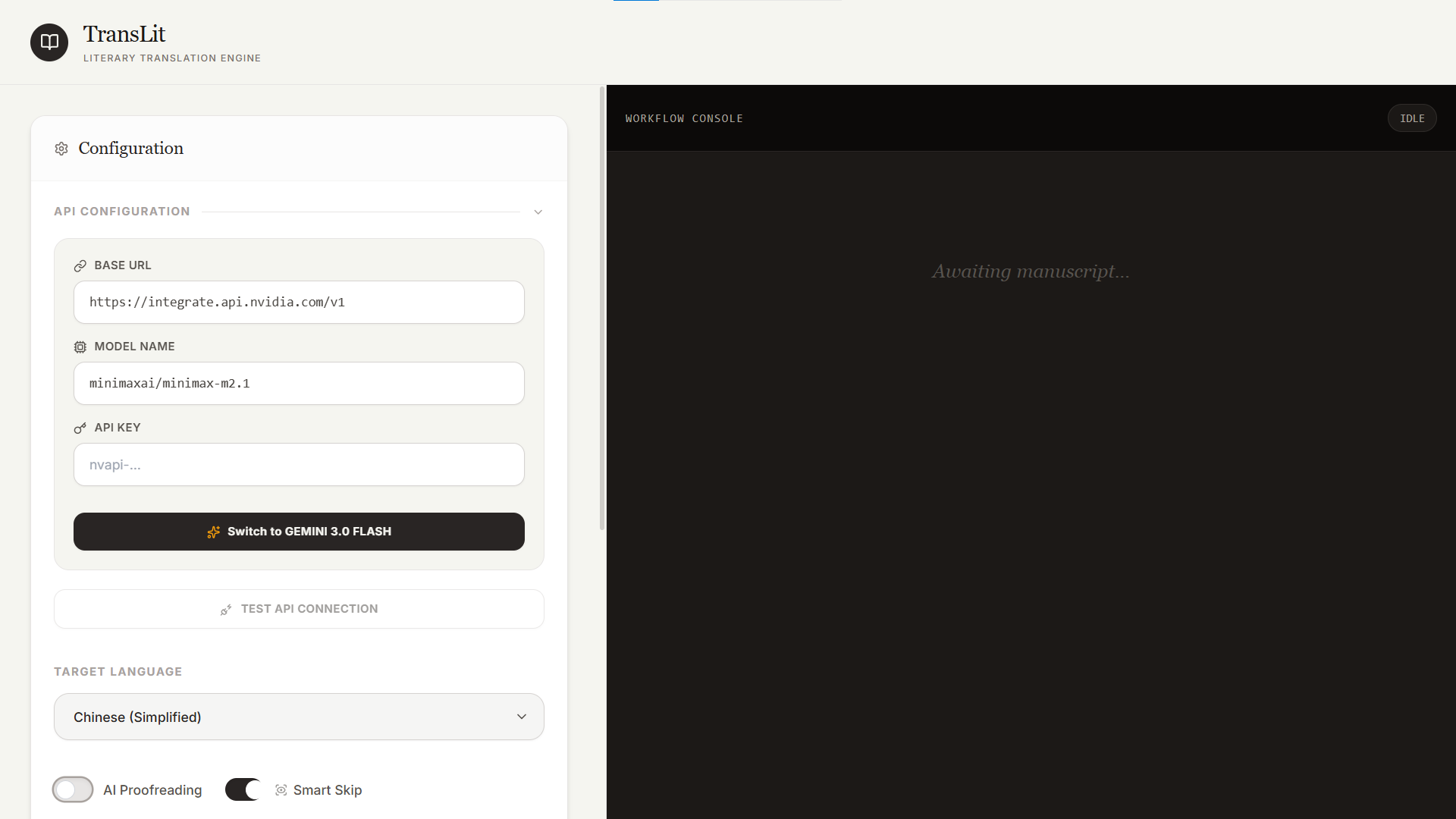
I integrated my previous EPUB translation app, allowing it to call both Gemini and third-party APIs. I also added a caching feature so translations can resume from a breakpoint.
I had Gemini summarize the processing flow and technical details itself:
Parsing and Extraction: Uses JSZip to read the EPUB archive. Uses the browser's built-in DOMParser to parse the
content.opfandtoc.ncxfiles to obtain the book's metadata, reading order, and table of contents. Iterates to extract XHTML text and image resources.Dimensionality Reduction (XHTML -> Markdown): Uses the Turndown library to convert XHTML into Markdown markup. Configures custom rules to discard redundant HTML attributes and flattens h1-h6 headings to reduce the number of tokens processed by the large language model.
Model Calling (Translation and Proofreading): Iterates through chapters, calling the configured API endpoint via fetch to execute the prompts. To address the issue of Markdown asterisks (
*) failing boundary parsing in a Chinese context, the prompt strictly mandates the model to use<b>and<i>HTML tags instead of Markdown emphasis syntax.Restoration Conversion (Markdown -> XHTML): Uses the marked library to convert the translated Markdown text back into HTML strings. Uses regular expressions to match and rewrite image
srcpaths, directing them to the decompressed internal image directory.Reassembly and Packaging: Embeds the generated HTML strings into standard XHTML skeletons. Injects a custom Chinese typography CSS stylesheet. Uses JSZip to repackage all text, images, and metadata files into a
.epubformat and triggers the download.
🗺️ Semantic Topographic Map of Obsidian Vault
Seeing Shaonan post on Xiaohongshu about "vectorizing thousands of notes into a knowledge map," I used Gemini CLI to replicate a version for my Obsidian vault.
Initially, I wanted to use QClaw, but its modeling capabilities were still too weak. So I had QClaw summarize the requirements from our interactive process into detailed prompts, and then sent them to Gemini CLI, completing it in one go.
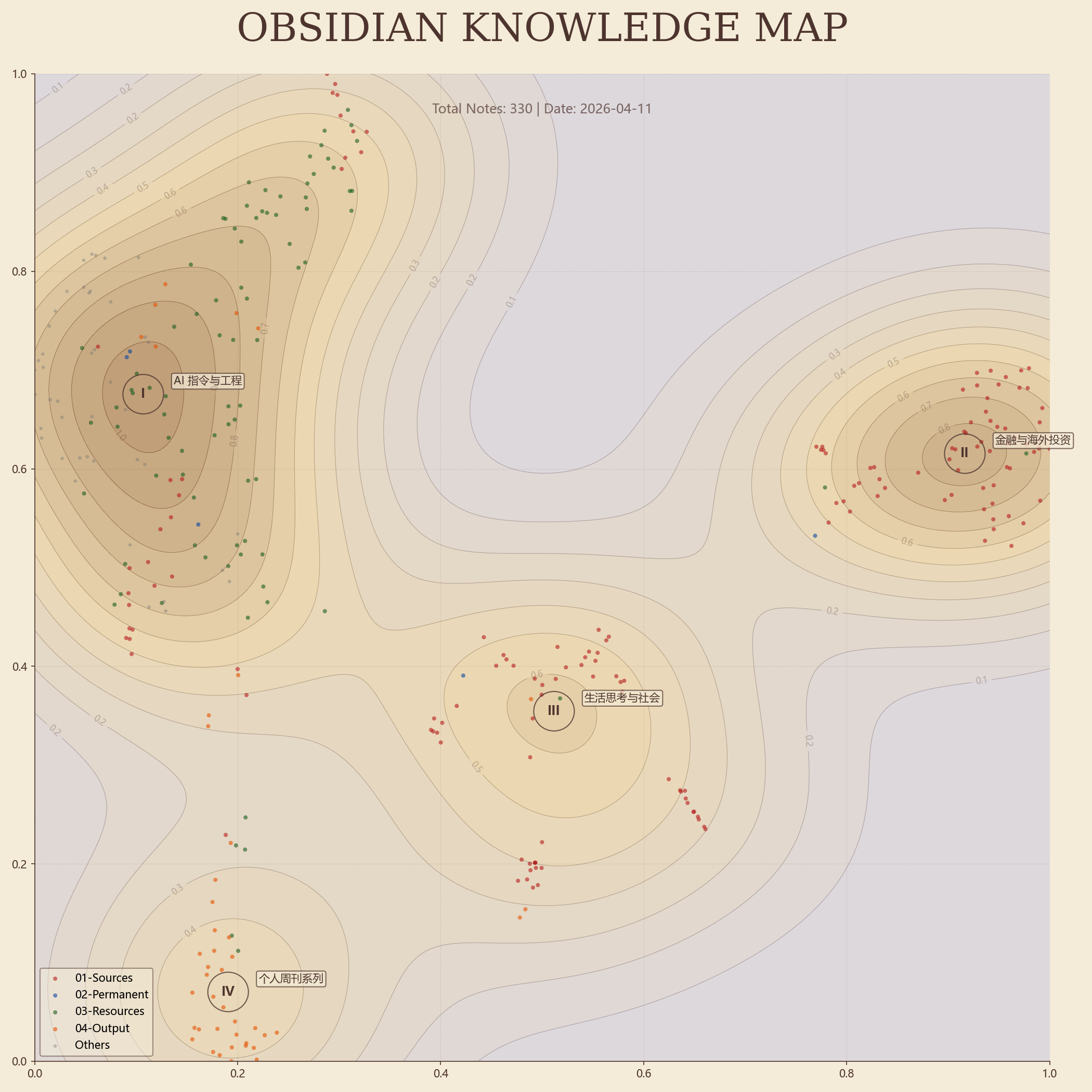
The process is very simple: use the embedding model jina-embeddings-v2-base-zh to convert texts into 768-dimensional vectors, project them onto a 2D plane, and draw a density distribution map.
Then, detect peaks in the density field and take the titles of the 15 closest notes to summarize into a category name.
I also made an interactive HTML version where you can explore the relationship between folders and themes, and click to jump to the corresponding Obsidian note:
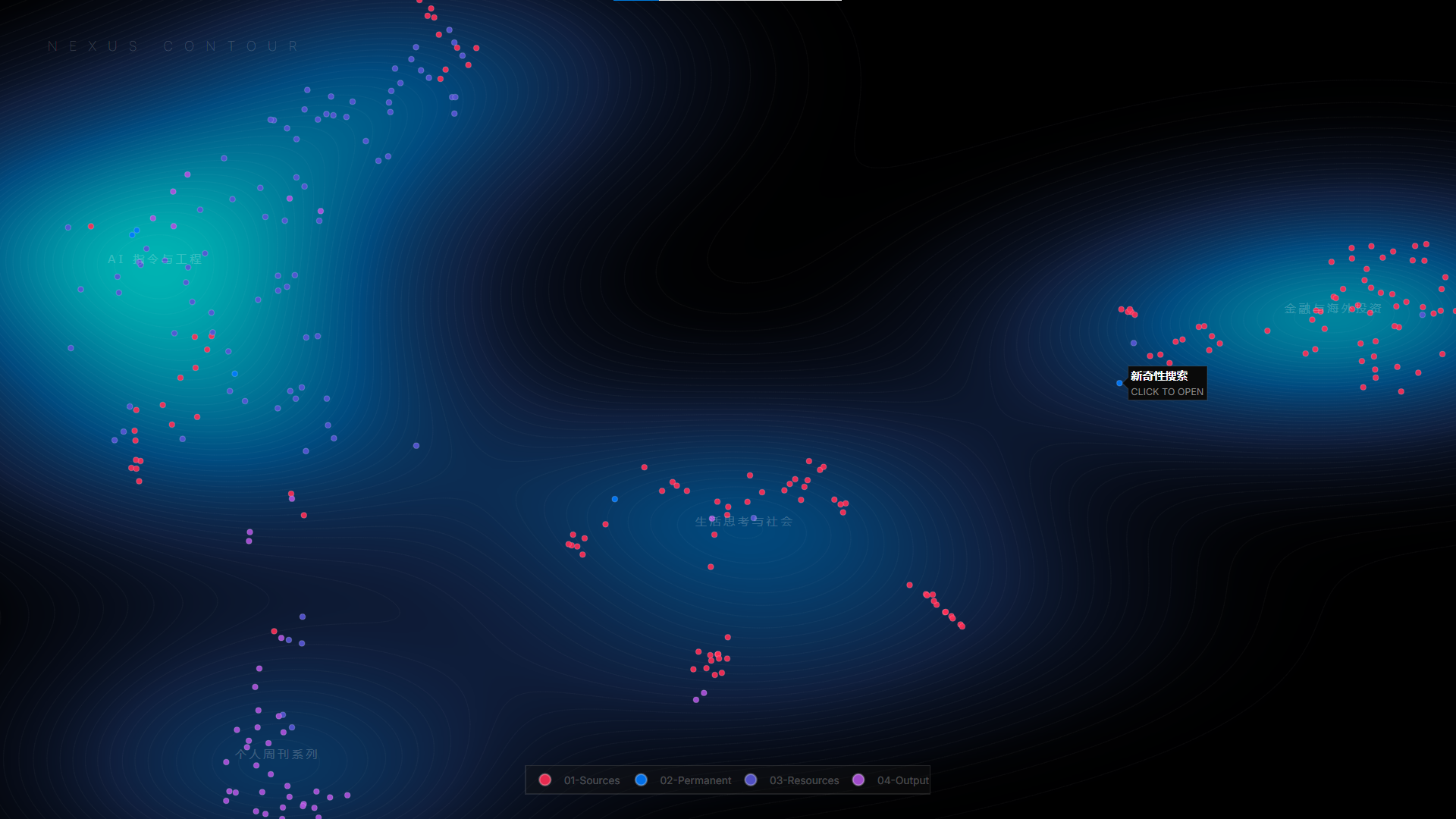
Compared to Obsidian's built-in graph view, this "grows naturally." You don't need to manually add tags or links (is that how you say it?), and you can still discover your areas of exploration.
To make it easier for future use, I also had Gemini CLI write a Skill, which has been uploaded to GitHub: Obsidian Knowledge Map. I used the Skill to try generating a "topographic map" of another note vault ( ):
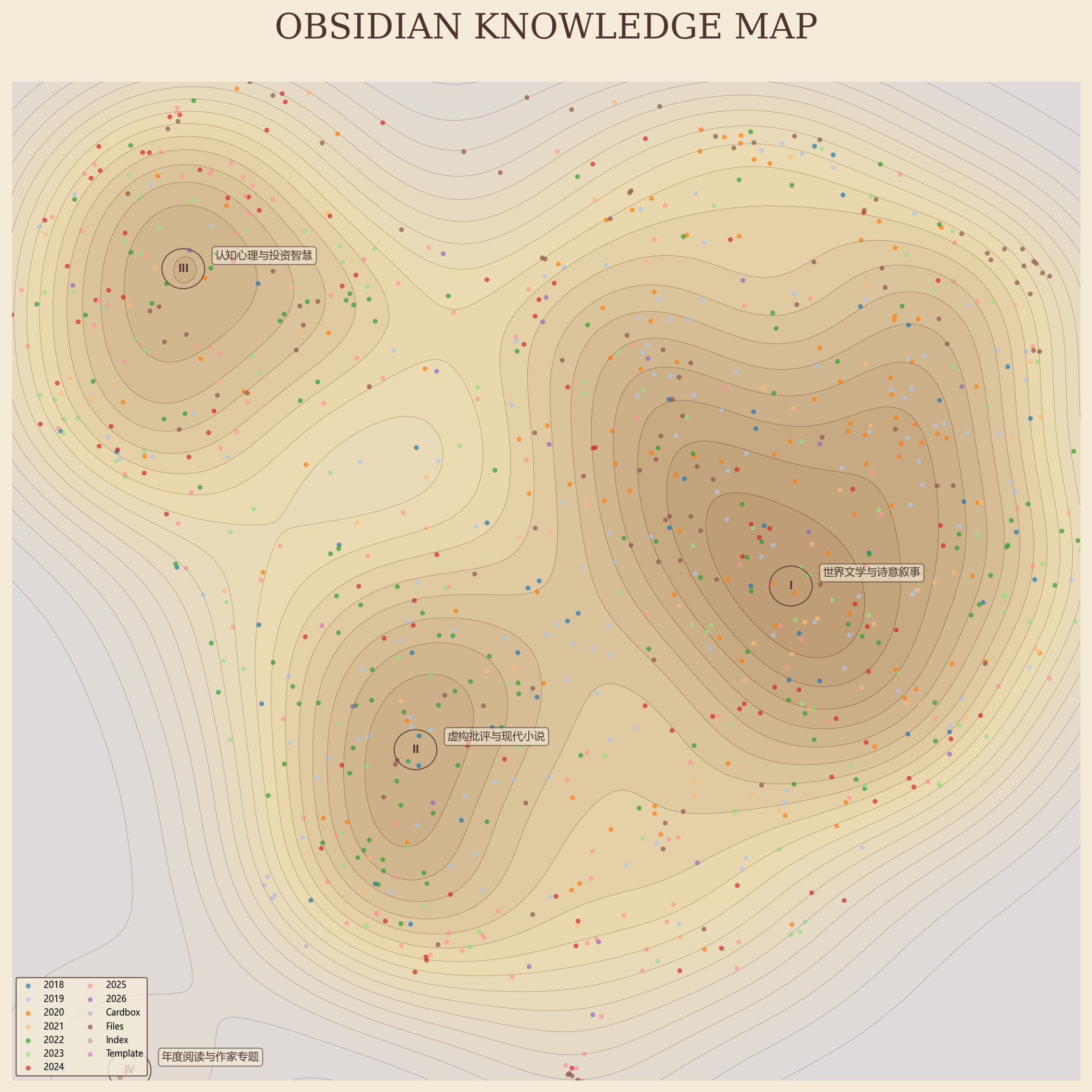
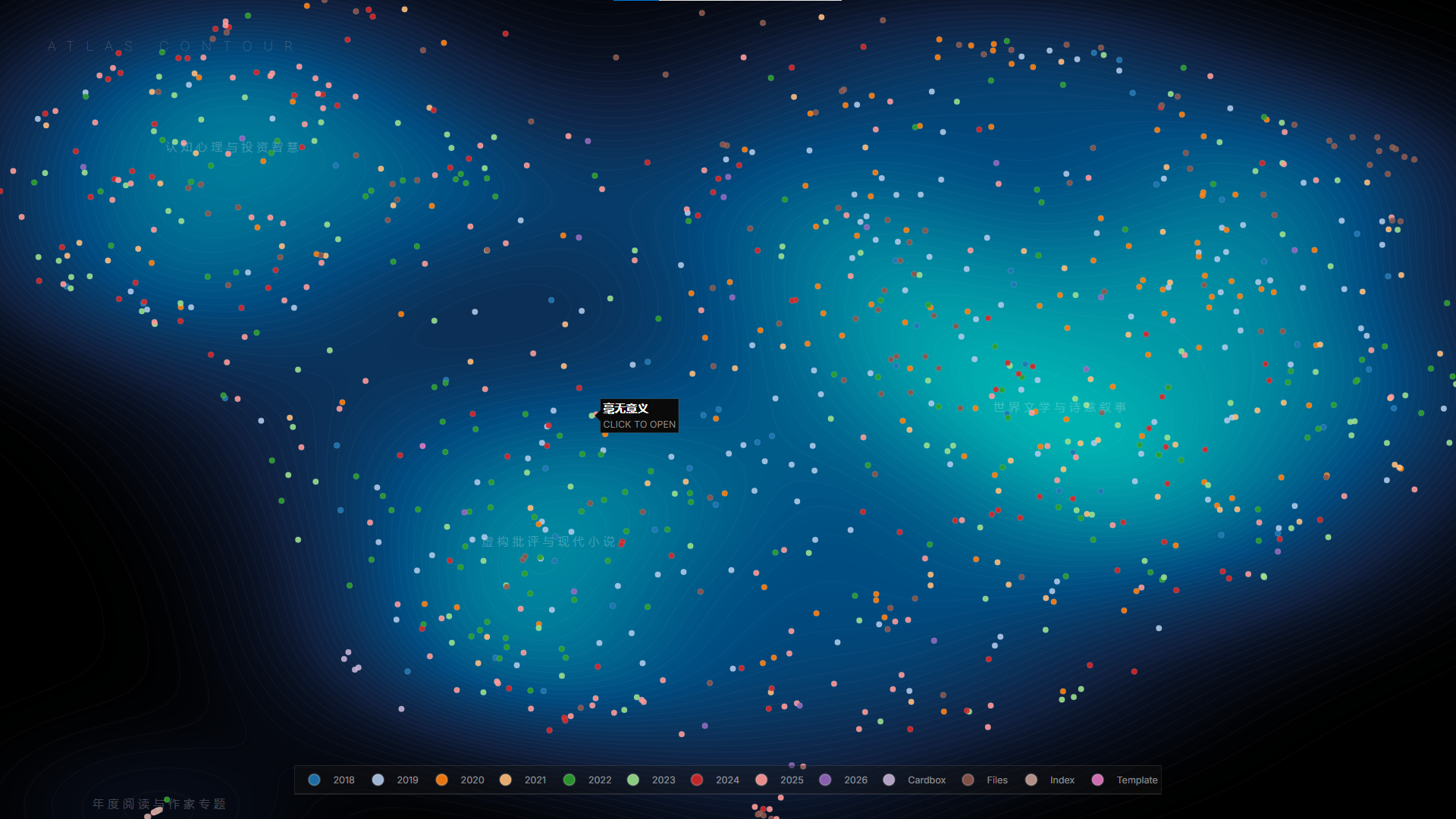
Here is the workflow summarized by Gemini CLI:
Phase 1: Spatial Analysis (Script Execution) Calls a Python script to perform vector calculations and UMAP projection. The script locates 6 cluster centers (peaks) in the density field, extracts the titles of the 15 notes within the neighborhood of each center, and outputs them to the Agent in JSON format.
Phase 2: Semantic Induction (Agent Reasoning) The Agent reads the raw title data output from Phase 1. Utilizing the language model's comprehension capabilities, it extracts semantic features for each set of titles and summarizes them into highly generalized category names. This process does not use hard-coded matching; category names are generated dynamically based on the note contents.
Phase 3: Artistic Rendering (Script Plotting) The Agent passes the generated category tags back to the script as parameters. The script completes the final contour map plotting, mountain peak annotations, and Roman numeral numbering.